
Imagine you’re buying a strawberry smoothie. It looks delicious, and the packaging leads you to believe that it’s healthy, natural, and full of vitamins. At home, you read the fine print and are shocked: It’s full of artificial flavors and additives, and contains no real fruit.
You’re angry and feel cheated. You wouldn’t drink something like that. But now imagine if the ingredient list were missing as well. As a consumer, you wouldn’t even know what you were actually consuming. Unthinkable, isn’t it?
That is precisely why the AI Act requires that synthetic media—the term used for content created by AI—be clearly and unambiguously labeled. This is so that consumers know what they’re being shown. And this applies both online and in print. But let’s take it one step at a time.
Table of Contents
AI-generated content is here to stay. We’ll show you how to label it correctly!
- Which AI-generated media are subject to labelling requirements?
- Do photo montages made from real photos and AI-generated content need to be labeled?
- Do photos or portraits retouched using AI need to be labeled as such?
- At what point does the AI Act define something as a deepfake?
- Who is subject to the AI labelling requirement?
- Where and how should AI labelling be done?
- AI Disclosure Requirements at a Glance
- Conclusion: Transparency as a Quality Indicator
Which AI-generated media are subject to labelling requirements?
The basic rule is easy to explain: As soon as you create content—whether text, images, video, or audio—using artificial intelligence, it should be labeled as such.
Artificially generated media are also referred to as synthetic media. There are a few exceptions to this general rule:
- Texts must be labeled only if they are synthetically generated and published automatically—for example, by an AI agent. A text that is generated by AI but reviewed, published, and endorsed by a human does not need to be labeled.
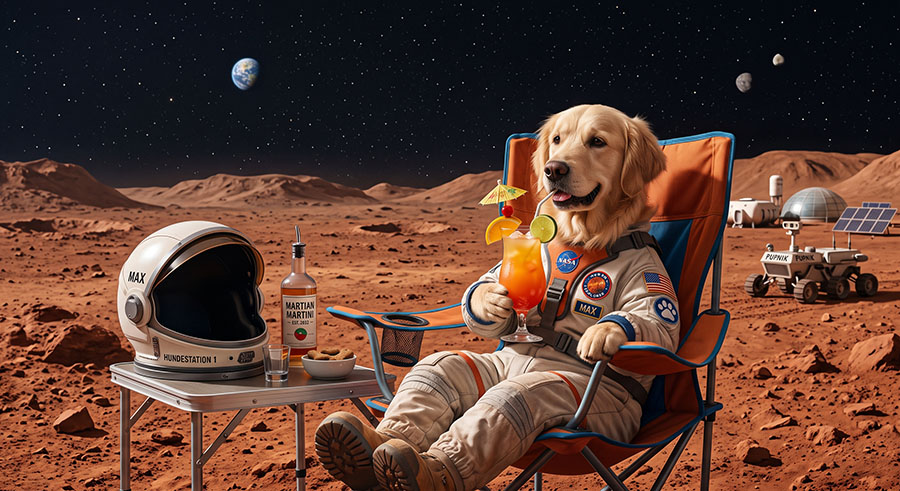
- Images that do not appear deceptively realistic do not need to be labeled. An example would be a picture showing a dog happily drinking a cocktail on Mars.
- Content used solely for internal purposes—such as for training—does not need to be labeled.
Nevertheless, we recommend labelling all content created using artificial intelligence.
Do photo montages made from real photos and AI-generated content need to be labeled?
Yes, AI-generated photo montages must be labeled as such.
Let’s say you take a photo of your company’s headquarters and use AI to add a bright blue sky and smiling people in the foreground. The company building is real, but the sky and the people are artificially created. Such montages must also be labeled.
The law states: As soon as AI-generated elements alter the overall impression of the image or distort reality, they must be labeled.
Do photos or portraits retouched using AI need to be labeled as such?
No, as long as the person is still recognizable.
Enhancing your portrait—for example, by smoothing out skin, whitening teeth, or removing blemishes—falls under the legal definition of digital image optimization (also known as AI-assisted retouching).
With the AI Act, lawmakers aim to prevent readers from being misled by synthetic media. This means that as long as the person in the portrait is still recognizable, AI-assisted edits do not require labeling. After all, this has been standard practice ever since Photoshop came along.
However, if the editing is so extensive that the face is altered to the point where the person is no longer recognizable, the image must be labeled as such.
At what point does the AI Act define something as a deepfake?
The term “deepfake” is a combination of the terms “deep learning” (the process by which computers learn in depth) and “fake” (counterfeit).
A deepfake occurs when actions, faces, and/or voices that real people have never actually performed are attributed to them in a deceptively realistic manner.
Even though such deepfakes are not prohibited per se, one should still be aware that one can quickly find oneself in violation of the law.
Deepfakes must always be labeled as such!
Who is subject to the AI labelling requirement?
The AI disclosure requirement applies to all entities that conduct business or engage in professional activities online.
It makes absolutely no difference whether you’re a sole proprietor or a large corporation. As soon as there’s a commercial intent behind it, you’re bound by the rules.
Private individuals with purely personal blogs are exempt from this strict transparency rule. But be careful: the line between personal and public is blurry. As soon as a personal blog achieves a large audience or even generates advertising revenue, it is considered professional.
Deepfakes must always be labeled!
Where and how should AI labelling be done?
First of all: A general and obscure statement in the legal notice such as “This website uses some AI-generated images” is not legally sufficient.
The disclosure must appear directly on the content in question—either through a traditional image caption or a visible watermark in the image.
In addition, this information must be stored in the file’s metadata. Most AI image generators store this information in the metadata or embed it directly as an invisible watermark within the image.
One example worth mentioning here is the C2PA standard (Coalition for Content Provenance and Authenticity). C2PA is an open standard for digital provenance and is embedded as a cryptographic watermark.
With this online tool, you can use drag-and-drop to check whether images were generated by AI.
AI Labelling Requirements at a Glance
Overview of the most relevant media and their labelling requirements under the EU AI Act.
| Media Type | Labelling Requirements | Note |
|---|---|---|
| AI Text | No | As long as a human reviews, publishes, and takes responsibility for the AI-generated texts |
| AI Image | Yes | Except that the AI image is obviously fictional (e.g., a dog on Mars drinking a cocktail) |
| AI Illustration | No | AI illustrations do not depict reality |
| Mixed Media (AI + Photo) | Yes | AI image montages do not reflect reality |
| AI Portrait Retouching | No | As long as the AI retouching involves cosmetic corrections |
| AI Video | Yes | Except that the AI video is obviously fiction |
| AI Audio | Yes | With AI audio, it’s almost impossible to tell the difference between reality and fiction |
| Deepfake | Yes | Requires the utmost transparency; may result in legal action; we strongly advise against it! |
Conclusion: Transparency as a Quality Indicator
Synthetic media have become part of our everyday lives—and they’re here to stay. So let’s not kid ourselves:
The use of AI is ubiquitous, and most people have already created content with the help of AI.
If we all play fair and respect transparency requirements, we’ll all benefit from the amazing technological possibilities that AI offers us. When in doubt, it’s always better and more honest to label content rather than take an unnecessary risk.
Most AI-generated images already contain an invisible watermark that can be detected using special software. It’s safe to assume that, in the future, web crawlers will automatically scan websites for AI-generated content and the corresponding labelling—and penalize those who fail to comply with the labelling requirement.
That’s why our clear recommendation to everyone is: It’s better to be generous in complying with the AI labelling requirement than to regret it later.
You may also be interested in the following article:

SEO for AI – 20 questions and answers about Generative Engine Optimization0 (0)
For almost three decades, ranking number 1 on Google was the non-plus-ultra in online marketing. AI chatbots and AI search engines are changing this paradigm. Visibility today requires not only SEO, but also GEO.